Posts

'The Fairies of Moehau', translated and edited by Margaret Orbell, published in 1968

Fairies, or patupaiarehe, were said to be much like human beings, but with white skins and red hair. They lived on the mountain tops. Most of the time they could not be seen, though sometimes on a misty day a tohunga might catch a glimpse of them.  One of the places most frequented by the fairies was Moehau, the high mountain at Cape Colville on the Coromandel Peninsula. Edward Tregear, in his book The Maori Race (p. 523), tells us that Moehau was so sacred to the fairies that few people dared approach it, but that ‘those who did so had wonderful stories to relate of seeing fairy-forts made of interlaced supplejack, and of finding plantations of gourds. If anyone attempted to lift one of these gourds it was found to be too heavy to move’. John White says that the fairies' pa were in dense forest on the heights of the mountain, and that no man could make a way through the woven supplejack that surrounded them ( Journal of the Polynesian Society , vol. 33, p. 211).  The mountai...

'Raukawakawa: The Great War Canoe that was never Launched', a story published in 1905

Image
New Zealand Illustrated Magazine , Issue 309, 1 August 1905, Page 371

Concerning Te Wharewharenga-i-te-rangi of Ngāti Hako, a brief extract from 'Ancient History of the Maori'

Ko whare, ara ko wharewharenga-i-te-rangi. Ka noho a Whare me tana iwi i Hau-raki i to ratou kainga i Taumaha-rua i roto i te awa o O-hine-muri. Ka tae ki aua ra ka pouri te ngakau o Whare ki te mahi whakatete o tana iwi ki ana whakahau, a ka riri aia, a ka taraa te rangi i Whare kia ua te ua o te rangi kia tinga ai te manawa whakahi o tana iwi ki aia. Nei koa he Tohunga makutu a Whare, a tutu ana te awha, tuku tonu te ua, ano ka pukea nga kainga o tana iwi e te wai ka karanga atu tana iwi ki a Whare ka mea, “E Whare e, taraa te rangi kia mao ai.” Ka oho atu a Whare ki ta ratou aue ka mea “E kore a Whare e tara i te rangi, he ua haere [tuku] mai i roto i Kete-riki,” a raru ana tana iwi i te mate kai, i te mahi a te waipake, ka ea te mate o Whare i te ua o te rangi. Ko Kete-riki, he maunga i te taha o te Aroha, i tua tata atu o te kainga i noho ai a Whare ma. Ancient History of the Maori , Volume IV, by John White, p. 50

An 1849 Letter from Ngāti Pāoa regarding land

Image
Daily Southern Cross , Volume V, Issue 225, 24 August 1849, Page 4

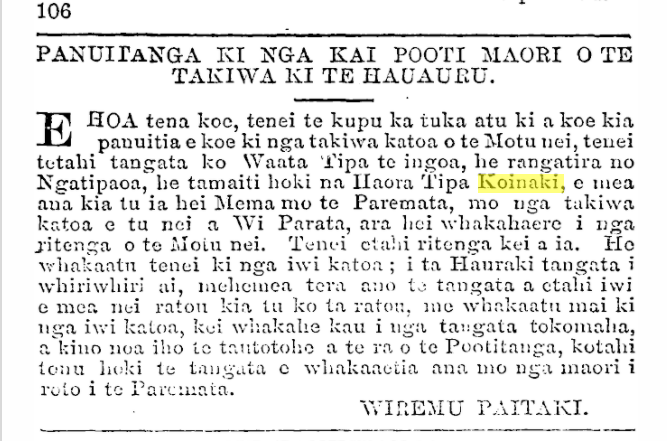
A Public Notice concerning Waata Tipa of Ngāti Pāoa running for Parliament, 1875

Image
Te Wananga, Volume 2, Issue 31, 4 December 1875, Page 398

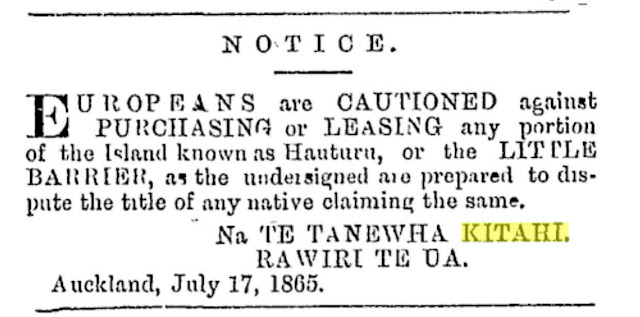
Hauturu, Little Barrier Island (Europeans are cautioned against purchasing or leasing), 17 July 1865

Image
  Daily Southern Cross, Volume XXI, Issue 2496, 20 July 1865, Page 1

The Journey of Tainui to Aotearoa, versions found in 'Ancient History of the Maori' by John White

The following versions of the story concerning the journey of Tainui from Hawaiki to Aotearoa appear in Volume IV of Ancient History of the Maori by John White. (Government Printer 1888) These versions are attributed to Ngāti Maru and the first version was undoubtedly extracted from a manuscript by Hoani Nahe. An English translation, again sourced from Ancient History of the Maori, appears after each version. You can read about John White here . Version 1 (pp. 21-23) He korero mo te haerenga mai o nga tupuna o te Maori i Hawa-iki. Ka timata i ta nga kaumatua Maori wahi i mohio ai. Ko te take i haere mai ai te tangata Maori ki tenei motu he whawhai nui noa atu i Hawa-iki; tini noa atu nga tangata i tu ki taua whawhaitanga, a he tini ano hoki nga tangata ki te hinganga. Ko te ingoa o tenei parekura ko te Ra-to-rua. No te taenga mai ki konei ki Ao-tea-roa nei ka titoa atu he waiata mo taua parekura nei mo te Ra-to-rua. Nga tangata nana tenei parekura ko Heta tetahi, ko Ue-nuku tetahi; na...

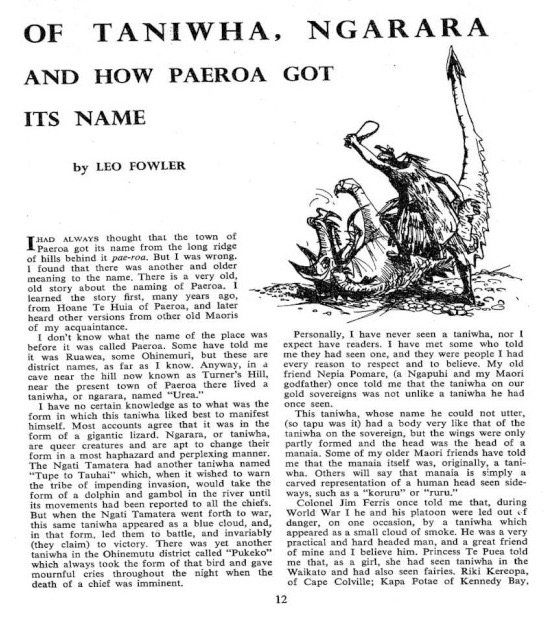
'Of Taniwha, Ngarara and how Paeroa got its name', by Leo Fowler, March 1959

Image
Te Ao Hou, March 1959, Page 12 Here is an unedited version of this text. I have placed some suggested corrections in the text using square brackets [ ]. OF TANIWHA, NGARARA AND HOW PAEROA GOT ITS NAME by LEO FOWLER  I had always thought that the town of Paeroa got its name from the long ridge of hills behind it pae-roa . But I was wrong. I found that there was another and older meaning to the name. There is a very old, old story about the naming of Paeroa. I learned the story first, many years ago, from Hoane [Hoani] Te Huia of Paeroa, and later heard other versions from other old Maoris of my acquaintance.  I don't know what the name of the place was before it was called Paeroa. Some have told me it was Ruawea, [Ruawehea] some Ohinemuri, but these are district names, as far as I know. Anyway, in a cave near the hill now known as Turner's Hill, near the present town of Paeroa there lived a taniwha, or ngarara, named “Urea.” [Ureia] I have no certain knowledge as to what was th...

'Maori War Flag, Romantic History', 1939

Image
Poverty Bay Herald, Volume LXVI, Issue 19961, 12 June 1939, Page 14

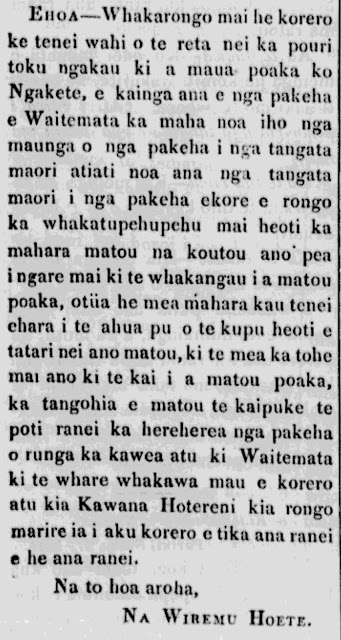
Letter of Complaint by Wiremu Hoete of Ngāti Pāoa regarding Pākehā of Waitematā stealing his pigs, 1842

Image
Te Karere o Nui Tireni, Pukapuka 1, Nama 12, 1842, 52 

The Confiscation of Lands following the Waikato War, including Pūkorokoro (Miranda), 1865

Image
This notice appeared in an 1865 edition of Waka Maori. The notice was issued by Governor George Grey and concerns the extend of the Waikato Lands that were taken by the Government following the Waikato War. The lands that were confiscated included Pūkorokoro in Hauraki. Waka Maori, Volume II, Issue 41, 7 January 1865, Page 1

Hauraki signatories on the sale deed for the Mahurangi and Ōmaha Blocks, 1841

Here is an extract from the sale deed for the Mahurangi and Ōmaha blocks, dated 13 April 1841. The source of this extract can be found here: http://nzetc.victoria.ac.nz/tm/scholarly/tei-Tur01Nort-t1-g1-g1-g1-g6-g1-t1.html#n280 Mahurangi  and  Omaha  Block , Mahurangi  District . Kia mohio  nga tangata katoa i tenei Pukapuka ko matou nga Rangatira me nga  tangata o Ngatipaoa o Ngatimaru o Ngatitamatera Ngatiwanaunga ka tuku ka hoko atu nei i enei kainga o matou (ko Manurangi ko Omaha nga ingoa) me nga kainga katoa e takoto ana i roto i nga rohe e tuhituhia ana ki tenei Pukapuka kia te Karaka te kai tiaki o nga Tangata Maori mo te kuini o Ingarangi mo ona uri iho mo tetahi tangata wahine ranei e waiho ai e Ingarangi hei kingi hei kuini ranei ake tonu atu te whenua nga rakau katoa nga  wan  katoa nga awa katoa nga keringawai katoa, nga taiapa katoa nga motu katoa (kihai i hokona i mua ake nei) menga aha noa iho i runga i raro o enei kainga katoa o ma...